From Dundee to Deep Space: Artemis II Successfully Launched
The countdown for NASA’s Artemis II test flight has begun at the Kennedy Space Centre in Florida. The upcoming launch will mark the first time humans will orbit the moon since the Apollo 17 mission in 1972. The weather is currently 90% favorable for liftoff during the launch window. During the mission, four NASA astronauts will test the Orion spacecraft’s systems and…
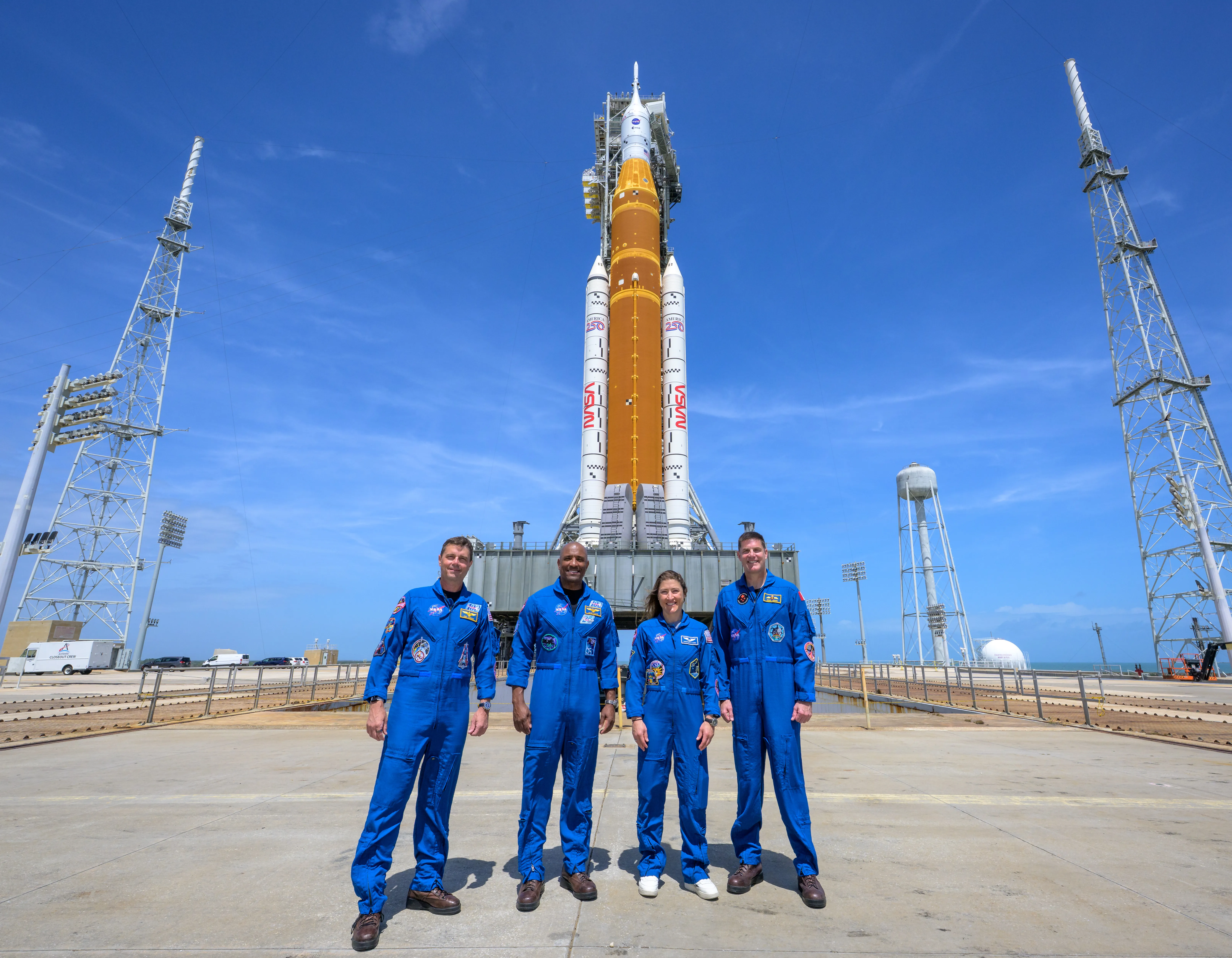
NASA astronauts Reid Wiseman, Victor Glover, Christina Koch, and Jeremy Hansen visit NASA’s Artemis II SLS (Space Launch System) rocket and Orion spacecraft. Photo: NASA/Bill Ingalls.
The countdown for NASA’s Artemis II test flight has begun at the Kennedy Space Centre in Florida. The upcoming launch will mark the first time humans will orbit the moon since the Apollo 17 mission in 1972. The weather is currently 90% favorable for liftoff during the launch window.
During the mission, four NASA astronauts will test the Orion spacecraft’s systems and examine its capabilities to keep humans alive in the deep space environment.
A Dundee Firm has played a crucial role in the development of parts and in providing specialist equipment for the mission. They provided high-speed cable assemblies, which are crucial for ensuring the mission’s communications systems.
The equipment is built to withstand the extreme vibration and temperature changes involved with space travel. The process required several stages of rigorous testing to ensure the equipment is suitable to be considered space-grade and utilised in the mission.
Despite the technological and scientific challenges of manned space flight, there are several legal issues regarding human activities in space. The Jute Journal interviewed Dr Alexander Simmonds, an expert in Space Law at the University of Dundee and author of The Space Legislation of the United Kingdom, published by Brill in 2025.
It is an exciting time for those with an interest in space, as Dr Simmonds said:
“Space is always exciting, now particularly we’ve got Artemis 2 that will be followed by Artemis 3 (the mission will test out systems and operational capabilities to prepare for an Artemis 4 moon landing in 2028).”
Photo: NASA
In a world with escalating financial, ethical and environmental challenges, should we be spending all this money on space exploration, when we can redirect the funding to solve real problems on earth instead? Dr Simmonds said:
“It is a question that has been asked since space programs began. I believe Neil Armstrong was asked the same, and he said, we don’t have to choose one or the other. We can do both. It is within our ability to do both.”
“Ultimately, the survival of the human species may depend on space travel since the Sun, by many scientific estimates, will eventually die and possibly even expand, which would make the Earth uninhabitable. However, the amount of environmental damage caused by space activities cannot be understated, and this is well documented.”
Despite the negatives, an account that is often overlooked is that:
“Space usage helps fight against climate change. Because we have got satellites up there that monitor the ice caps melting, patterns of crop failure on earth and other relevant matters.”
“In terms of the environmental aspect, an operator of space activities must submit an Assessment of Environmental Effects (AEE). So far, the assessments that have been produced are very comprehensive and robust, hundreds of pages. It shows that operators are taking the environmental aspects of their activities seriously.”